19.01.2026
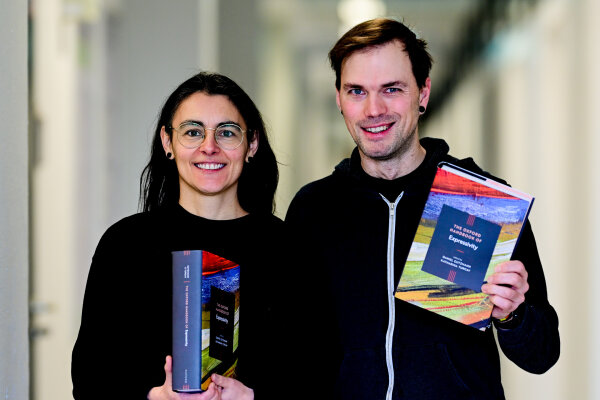
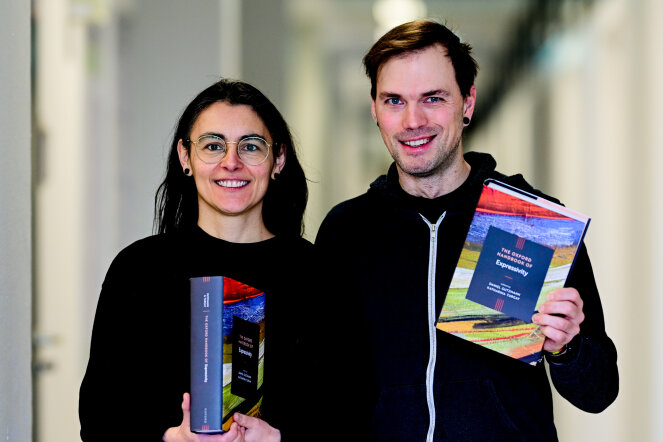
The Oxford Handbook of Expressivity, edited by Katharina Turgay and Daniel Gutzmann, was published at the end of 2025 by Oxford University Press.
Expressivity is the essential property that allows natural language to not just describe something in the world, but to directly express or display the speaker's attitudes or emotions. In a total of 50 chapters spanning more than 1,300 pages, the handbook provides a comprehensive and critical overview of the state of the art, opens up new perspectives, and is aimed at linguists, philosophers, and cognitive scientists.
The Oxford Handbook of Expressivity, edited by Katharina Turgay and Daniel Gutzmann, was published at the end of 2025 by Oxford University Press.
Expressivity is the essential property that allows natural language to not just describe something in the world, but to directly express or display the speaker's attitudes or emotions. In a total of 50 chapters spanning more than 1,300 pages, the handbook provides a comprehensive and critical overview of the state of the art, opens up new perspectives, and is aimed at linguists, philosophers, and cognitive scientists.
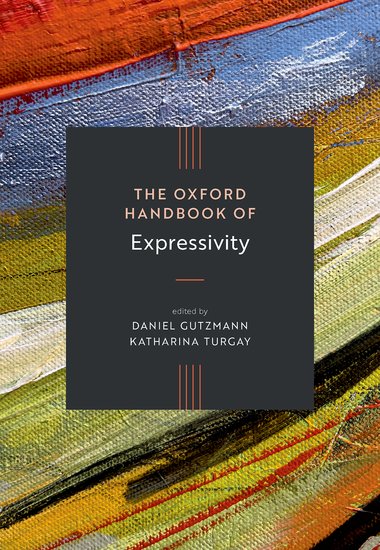
Following the editors' introduction, which outlines the expressive turn in linguistics, the volume is divided into five parts. Part I lays out the historical background and foundations of expressivity in philology, philosophy, semiotics, and rhetoric, before Part II shows how it plays a major role in all linguistic domains, fields of research, and frameworks, from syntax and semantics to corpus linguistics and neurolinguistics. Chapters in Part III explore specific linguistic phenomena such as slurs, interjections, honorifics, and metaphor, while those in Part IV show how the concept of expressivity is valuable in domains beyond traditional linguistic boundaries, including in pedagogy, law, and music. Finally, Part V presents a cross-linguistic perspective, revealing how expressivity manifests differently across a range of languages, from French and German to Japanese and Mandarin.
1. Expressivity: an introduction, Daniel Gutzmann and Katharina Turgay
Part I. Background and foundations
2. Expressivity in early philosophy and philology, Laurence R. Horn
3. Expressivity in modern philosophy of language, Thorsten Sander
4. Expressivity in semiotics, Robert E. Innis
5. Expressivity in rhetoric, James Martin
6. Expressivity in and before language, Dorit Bar-On
Part II. Linguistic domains
7. Expressivity and the lexicon, Michael Adams
8. Expressivity and morphology, Jeffrey P. Williams
9. Expressivity and syntax, Andrés Saab
10. Expressivity and multidimensional semantics, Daniel Gutzmann
11. Expressivity and dynamic semantics, Robert Henderson
12. Expressivity and semantic change, Lukas Müller
13. Expressivity and speech acts, Maria Paola Tenchini and Aldo Frigerio
14. Expressivity and relevance theory, Manuel Padilla Cruz
15. Expressivity and construction grammar, Rita Finkbeiner
16. Expressivity and discourse analysis, Konstanze Marx-Wischnowski
17. Expressivity and prosody, Mariia Pronina, Ingo Feldhausen, and Pilar Prieto
18. Expressivity and neurolinguistics, Shlomit Ritz Finkelstein and Lynne C. Nygaard
19. Expressivity and psycholinguistics, Filippo Domaneschi and Camilo Rodriguez Ronderos
20. Expressivity and corpus linguistics, Elizabeth Hanks, Niall Curry, Emily Sharp, Gavin Brookes, and Tony McEnery
21. Expressivity and computational linguistics, Tatjana Scheffler
Part III. Linguistic phenomena
22. Expressivity and adjectives, Fabian Bross
23. Expressivity and slurs, Katharina Turgay
24. Expressivity and interjections, Ulrike Stange-Hundsdörfer
25. Expressivity and honorifics, David Y. Oshima
26. Expressivity and pronouns, Patrícia Amaral
27. Expressivity and vocatives, Gerhard Schaden
28. Expressivity and intensifiers, Ulrike Stange-Hundsdörfer
29. Expressivity and information structure, Andreas Trotzke
30. Expressivity and sentence types, Christopher Davis
31. Expressivity and metaphor, Ad Foolen
Part IV. Further applications
32. Expressivity and bilingualism, Ariana N. Mohammadi
33. Expressivity and pedagogical linguistics, Andreas Trotzke
34. Expressivity and perspectivity, Stefan Hinterwimmer
35. Expressivity and gestures, Cornelia Ebert and Sebastian Walter
36. Expressivity and emojis, Patrick G. Grosz
37. Expressivity and the media, Andreas Osterroth
38. Expressivity and music, Patrik. N. Juslin
39. Expressivity and lying, Katharina Felka and Andreas Stokke
40. Expressivity and law, Elyse Methven
41. Expressivity and speech synthesis, Andreas Triantafyllopoulos and Björn Schuller
Part V. Expressivity across languages
42. Expressivity in German, Daniel Gutzmann and Katharina Turgay
43. Expressivity in French, Pierre-Yves Modicom
44. Expressivity in Brazilian Portuguese, Renato Miguel Basso and Luisandro Mendes de Souza
45. Expressivity in Spanish, Andrés Saab
46. Expressivity in Arabic, Marwan Jarrah and Sukayna Ali
47. Expressivity in Modern Hebrew, Nora Boneh
48. Expressivity in Chinese, Qiongpeng Luo
49. Expressivity in Japanese, Osamu Sawada
50. Expressivity in sign languages, Rachel Sutton-Spence and Donna Jo Napoli

Copyright © Team Sprachsystem 2026
Last update: Jan 19, 2026